 English Talk
Best App to Learn to Speak English Fluently at Home
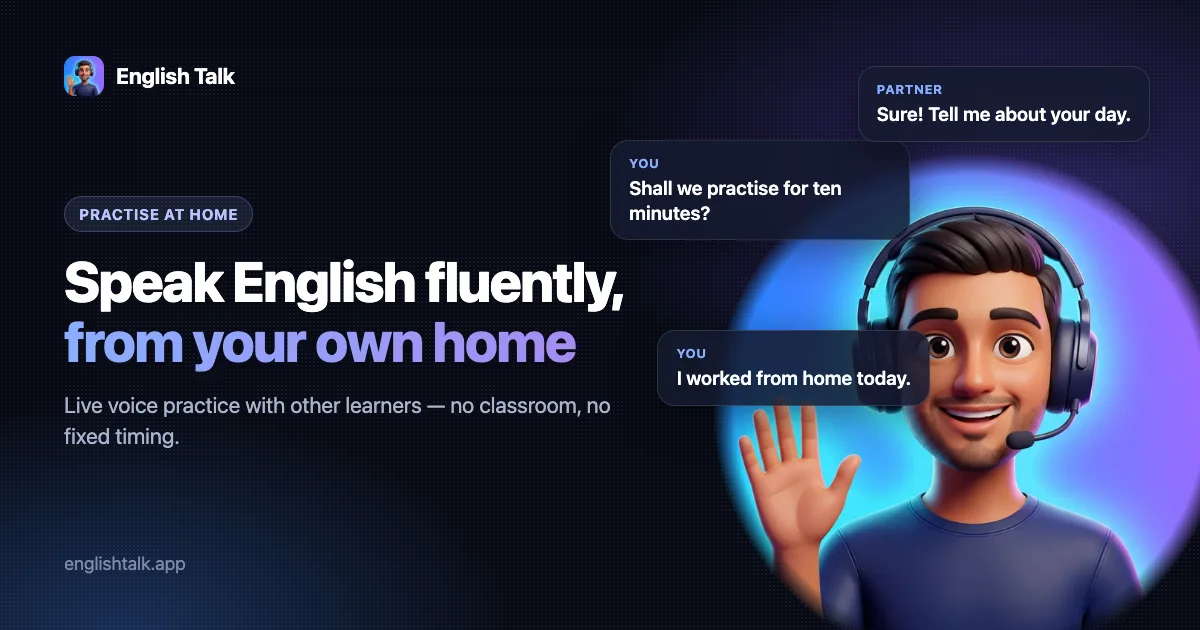
It has now been extremely easier at home to learn to speak English fluently through the use of digital platforms that attribute to real conversation practice. Most students know about grammar, have handy vocabulary and are able to read English easily and even then hesitate when maintaining a conversation. This can be explained by the primary lack of speaking frequently. This can be filled by selecting the most appropriate app to learn how to speak in English so that learners have more chances to speak in English in real-life situations.
The process of speaking differs to reading or writing since it involves thinking at a fast pace and reaction within seconds. A learner can be aware of proper words but will still be unable to create the words automatically in the flow or dialogue. That is why it is necessary to practice regularly. A good English speaking application ought to make the learners talk as much as possible rather than doing grammar drills, or learning new vocabulary.
English Talk is modeled based on live voice speaking with other learners. It enables the users to select a level and find someone who is also practising the English language. This practice concentrates on the actual speaking, as opposed to lengthy lessons and intricate knowledge systems. To learners who seek the most proficient app to learn how to speak English, having access to real-time conversation could facilitate more practical and appealing practice.
Flexibility is one of the largest benefits of home schooling. Conventional classes of speaking English typically involve rigid time schedules, commuting, and compulsory attendance. With a bedroom, study area, office, or any other silent location with internet access, it is now possible to practise using an English speaking app. This facility enables learners to incorporate practice in English speaking in their daily practice.
Fluency is enhanced by regular talking. Being fluent does not just mean to have correct grammar. It is also concerned with the ability to express ideas without stuttering and giving a natural response to the other person who is talking. English Talk defines fluency as the acquiring of a better flow and a quicker retrieval of words when conversing as opposed to experiencing difficulty in speaking without errors.
The most useful application to learn to speak English should then offer the ability to speak. Input skills mainly can be enhanced by listening to videos and podcasts, which can enhance comprehension and pronunciation awareness. An individual might be very good at hearing English but he or she may experience a stutter when responding. Practice in speaking will teach the mind to turn thoughts into words at a faster rate.
Live discussion can create that which is not entirely replicated by recorded courses. Somebody can pose a wrong question or shift the subject, talk in a different way, or demand a quick answer. Such scenarios assist learners to be at ease with the uncertainty of normal day communication. Practice partners may especially help in the development of confidence and a conversational flow when these are real.
In the English Talk, the voice conversations are based on levels, so the beginners will be able to initiate an easy stage. Students do not require initiating high-level discussions and complex words. Confidence can be slowly developed by mere discussion of day to day life, work, school or family, hobbies, travelling or normal activities.
Novices are doubtful as they fear committing grammatical errors. Nevertheless, too much worry about mistakes may hinder the process. Spoken communication is also enhanced since learners have confidence in finishing sentences and conveying ideas despite the imperfection of the language used. Correctness may be perfected, but self-confidence must be exercised.
The most useful application to learn how to speak the English language must not create any unnecessary pressure as well. Sometimes speaking to another learner may be easier when it comes to a practice than in the presence of a classroom, coworkers, or people who already know you as an individual. English Talk also keeps learners connected by means of voice conversations without detailed profile requirements that can provide a more straightforward speaking practice.
In conditions where speaking is practiced together with small daily routines, home-based learning can be facilitated. The aloud reading also assist in enhancing the pronunciation and movement of the mouth, whereas the aloud thinking in the English language teaches the learner to structure a sentence without having to translate each thought in another language. Short conversations or personal speaking sessions can be recorded too, which will make the progress more easily noticeable over the time.
An additional helpful strategy is to learn entire sentences and not individual words. Speech can be made easier through the use of everyday words and phrases like phrases to agree, disagree, explain, ask a question or make a continuation. Learners use less time to form each sentence word by word when words which are frequently used are recognized.
It is more important to be consistent each day than to study long a few times a week. Communicating in a little bit every day is one way to establish a habit and feel more comfortable with English. English Talk aids this practical method by enabling the learners to begin voice talks without necessarily attending long lessons until the time they can talk.
Most individuals who need to learn how to speak English best are planning their practical tasks like in an employment interview, meeting with colleagues in an office, conversation with customers, or college debate, or travel. Such situations demand beyond textbook learning. Students must be able to listen, hear the other person, be able to put their thoughts together and be able to answer without too much time lag.
Listening skills can be also developed by use of conversation practice. Each speaker possesses his/her rhythm, manner of pronunciation and sentence construction. Constant communication with various learners has the potential of exposing users to a greater range of spoken English and they can easily comprehend natural conversation not in a learning setting.
A pronunciation can be improved with time to go through speaking and listening. The aim does not require to be to imitate a specific accent. Generally more constructive communication of speech can be achieved through clear pronunciation and understandable order. The frequent speech will assist the learners to identify the hard sounds, enhance sentence rhythm, and feel less nervous with the new words.
Conversational learning of the words also makes the words easier to acquire in vocabulary development. Learners can spare the long lists to memorise and instead observe the need to use words repeatedly in their daily conversations. This renders vocabulary more applicable since it is related to real-life situations and individual communicational requirements.
The second positive side to having an English speaking app at home is since practice may continue in conjunction with the other methods of learning. Resources on grammar become useful to enhance accuracy, podcasts will facilitate listening, reading will widen vocabulary and live discussions can improve spontaneous talking. A balanced schedule can thus be used to aid various facets of English learning.
The learners can also practice using English Talk via a browser, and the Android app will be offered to those users who like using it on mobile devices. Free level calls are free and limited in time, with optional customizations offered to the user that choose to add more functionality.
Students ought to bear in mind that there is no particular application that can result in fluency without practice. Even the most suitable app to learn how to speak English will only work as long as the user speaks, makes mistakes and follows up the conversation, as well as practice at a certain rate. The improvements are typically observed in the form of the shorter pauses, improved sentences flow, increased confidence and lesser reliance on translation.
It is also convenient to practise the English language at the comfort of your home and especially when the students, professionals, homemakers, job seekers and business owners do not have sufficient time to venture in classroom courses. Without altering the whole daily routine, speaking opportunities can be provided via a smartphone or a browser-based platform.
Actually, the most appropriate application to study the skills of speaking English must eventually become more comfortable to talk on a regular basis. English Talk is based on the idea of live communication with other learners and assists a user to transform passive knowledge of the English language into active communication. Naturally, through talking, referring to real-life interlocutors and becoming comfortable with conversational talk, the learners will be able to get their fluency improved at home slowly but surely.
Free voice calls with other learners. Nothing to fill in, no signup.
Start in your browser → Get the Android app →