 English Talk
English Speaking for Beginners: A Simple Guide to Building Fluency and Confidence

English now plays a significant role in the communication, education, career progress and the daily interactions. The acquisition of English can be a new opportunity and it may enable individuals to communicate with more confidence. But there are a lot of new learners who are afraid to do it as they find it hard to learn new words, how to pronounce and how to build sentences, grammar. Knowing English basics in speaking English can help one in the process to learn easily, enjoy the process and make it more effective.
To speak fluent English, it is not enough to memorize some complex grammar rules and know thousands of words in a moment. Rather practice, mere chatting and continued exposures to the language can progressively enhance the communication skills. Novices talking a systematic learning schedule find it simplified to express themselves and to engage in daily interactions.
Understanding the Basics of Spoken English
The first step in learning spoken English will be to learn all the most frequent words, simple sentences, and expressions in everyday speech. These basic components allow learners to convey basic information without being confused with the complex concepts of languages.
The introductory level of English speaking entails getting acquainted with the different greetings, introductions, questions and general speech patterns. The use of phrases like Good morning, How are you? and What do you do? offers good basis of every day communication.
The acquisition of simple speaking capabilities also should include the knowledge of how words relate to constructing sentences with sense. Simple statements practice will enable learners to share their personal information, describe what they do on daily activities, and tell their needs.
Why Speaking English Is Important in Everyday Life?
English is common across work-related, educational, online and global communication. Basic speaking skills might enable people to communicate with people of other background and to obtain valuable information.
There is enhanced classroom attendance, enhanced presentations, and enhanced communication skills amongst students. English may be used by the working professionals in meetings, interviewing, communicating with customers and carrying out discussions with their colleagues at the workplace.
Beginners in speaking English also help in learning of a language that aid personal growth. It helps build confidence, enhance communication skills, and simplifies transactions in scenarios where English is widely used.
Start with Common English Words and Expressions
Vocabulary development is vital to learning spoken English. It is the beginners who need to first concentrate on words that they will use in everyday speech instead of trying to memorize hardsets of words.
Common family words, food, shopping, transportation, work and daily activity among others are very helpful. When such words are understood, one can easily build sentences and react in a natural way in conversations.
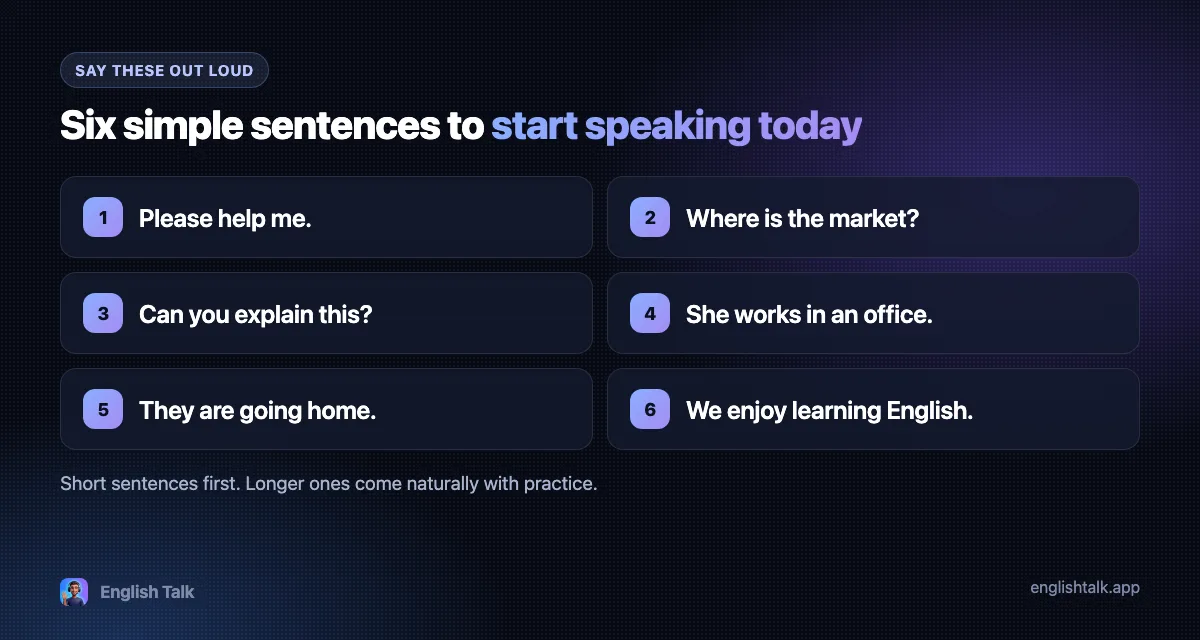
Considering such sentences like: Please help me, Where is the market? and Can you explain this? show how the use of simple words may help to achieve effective communication.
Frequent workout on vocabulary: it will enable learners to recall useful phrases and, overtime, widen their capabilities in talking about various subjects.
Practice Simple English Sentences Every Day
One of the most significant issues in the building of speaking confidence is sentence formation. Novices are likely to know some single English words but find it challenging to combine them to form sentences.
To overcome this difficulty, it is a good idea to start with short sentences. Sentences like, She works in an office, They are going home, and We enjoy learning English indicate sentence structure patterns commonly used.
An effective routine of English speaking for beginners must contain the practice of sentences related to the common everyday activities. Talking about morning activities, eating, traveling, and housework provide the possibilities of meaningful language practice.
Improve English Pronunciation Through Listening
Proper pronunciation plays an important role in communication. Clear pronunciation is not always required, even when words are correct and grammar is correct, talk can be hard to comprehend.
Spoken English is beneficial in learning novel sounds of words, rhythm in sentences and the natural speech patterns. Effective listening could be achieved through educational videos, listening to podcasts, listening to audiobooks, and conversations where the beginner is not spoken to with complex terms.
Pronunciation can also be enhanced by repeating words and sentences after native speakers or by repeating words and sentences spoken by native proficient speakers. The process will enable the learners to comprehend how we can use sounds to facilitate word connections in regular talk.
Build Confidence Through Regular Conversations
The most common problem with people studying English is the issue of confidence. Lots of novices are afraid of communicating due to the fact that they fear making grammatical or speech errors, sounding bad or being judged by others.
Nonetheless, errors are an inherent aspect of language learning. Each chat is a chance to enhance the communication and feel freer sharing ideas.
Exercising English speaking with beginners by talking in short dialogues can decrease deliberation. Discussing with friends, classmates, colleagues or language partner provides excellent practice opportunities when it comes to using new vocabulary.
Learn Basic Grammar for Better Communication
Grammar gives the framework to convey ideas precisely. Learners must be aware of some of the basic ideas of nouns, pronouns, verbs, helping verbs and commonly used tenses.
Daily communications especially require simple forms in past, present and future forms of tenses. Those constructions enable learners to talk about routine, describe past experiences, and tell about their future plans.
In the following case, a study of the following sentences will demonstrate how those forms of verbs can be used to convey time: She studies English, She studied English yesterday and She will study English tomorrow.

The process of learning grammar is simplified when the learners put it into meaningful sentences as opposed to learning these rules and not putting them into practice.
Use Technology to Practice Spoken English
Accessibility of learning tools in English language has enhanced due to the digital tools. Young apprentices can use mobile applications, interactive lessons, pronunciation exercises, or online conversations and practice according to their schedules.
A beginner friendly, English speaking app can offer basic exercises, which promote constant saying practice. Activities like conversation, listening exercises, and feedback on pronunciation can allow students to determine areas where they need to improve.
Technology also enables the student to revisit hard lessons, reiterate beneficial phrases and practice without having the stress of a normal classroom set up.
Engaging in communication through real conversations and combining them with digital learning materials would allow one to establish a balanced way of enhancing communication.
Develop the Habit of Thinking in English
It may take more time to translate all the sentences in a native tongue into the English language. Teaching students to think in English by itself assists students to respond more naturally.
However, simple English sentences can be used to have beginners describe familiar objects, surroundings and everyday activities mentally. As an illustration, when we view the weather and say, The weather is pleasant today, we have an opportunity to learn language practically.
The more this habit is created, the more learners feel comfortable in constructing sentences without the continuous use of translation.
Create a Consistent
English Speaking Practice RoutineFrequent training is stronger than practicing once in a while intensively. The attainable learning schedule enables the beginners to develop the skills at a slow pace and not to feel disappointed.
This can involve reading a brief English paragraph, listening to a conversation and repeating helpful sentences and speaking on a familiar topic, and become part of a daily routine.
Consistency is particularly relevant when it comes to English speaking by beginners since the language can be developed on basis of repetition and application.
Learners are also expected to study what has already been covered to reinforce the memory and keep up with the progress. Little advances made gradually may add towards increased speaking confidence.
Free voice calls with other learners. Nothing to fill in, no signup.
Start in your browser → Get the Android app →