 English Talk
How to Learn Spoken English for Beginners Step by Step?
Learning spoken English may prove challenging initially, particularly to learners who know the basic grammar but are not confident when talking. The positive thing is that fluency is built through daily practice, simple learning techniques and daily exposure to the language. It can be beneficial to know the steps to approach learning spoken English as a beginner in a step-by-step manner.
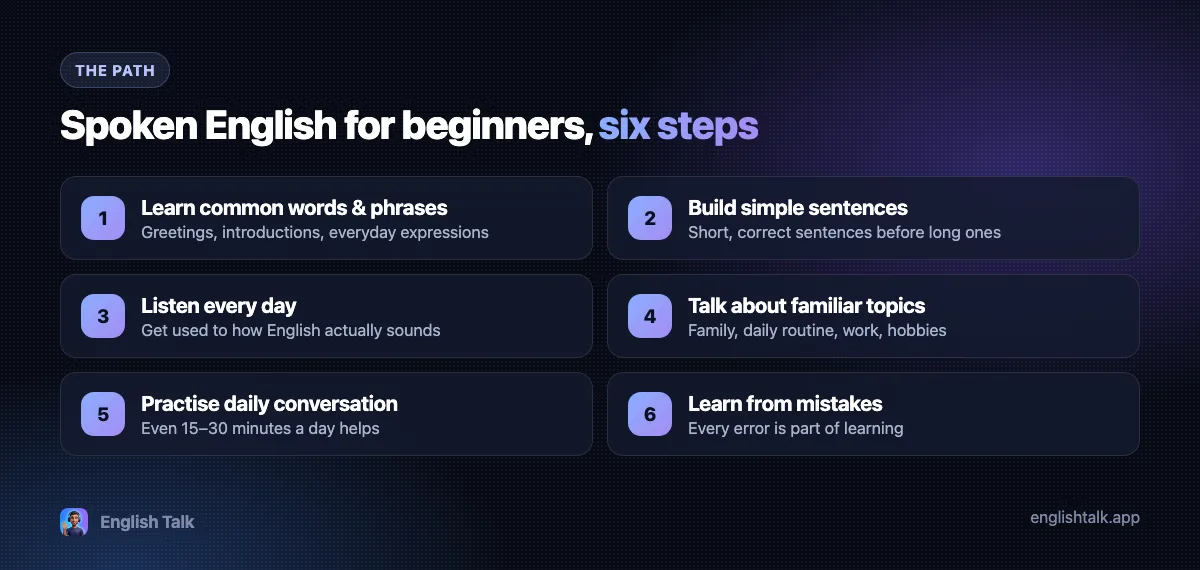
The initial one is the process of familiarizing oneself with the simplest English vocabulary and common phrases. Novices need not learn the complex vocabulary initially. Decent words in our everyday life at homes, work place, school, shopping areas, travelling and daily conversational means are more useful. Simple sentences, simple words: Learning to use practical vocabulary requires beginners to construct simple sentences, so that they can speak more naturally.
The second level is to target simple sentence constructions. Numerous novices are familiar with individual English words, yet they are unable to relate them properly. Simple sentences like introduction, greetings, questions and normal responses can form a solid foundation. Learning spoken English for beginners in a stepwise manner implies that one should use some simple patterns in beginning to learn before advancing to longer conversations.
Another area of knowledge of spoken English is listening. Listening regularly can assist beginners in getting their pronunciation, sentence rhythm, common expressions, and natural speaking patterns. Useful exposure may be via English videos, conversations, podcasts, and learning apps. Another benefit of listening to people day by day is that it can help to become a better listener and be able to express oneself more easily.
Talking on familiar subjects is one of the ways to practice. Novices can talk about their family, day to day activities, hobbies, education, work, favourite food or their weekend arrangements. These subjects are less difficult since the student is aware of what to say. This will ease the tension and allow speaking to become easier.
It should also be attended to by pronunciation. Proper pronunciation makes it easy to comprehend what the speaker is saying. Novices might start by reading/hearing brief English sentences and repeating them orally. Speaking slowly then gradually increasing to normal speed can assist in building up better pronunciation and self-confidence.
Learning how to learn spoken English as a beginning point in a step by step manner also involves learning effective phrases rather than just individual words. Words like seeking assistance, self-introduction, offering a opinion, agreement, disagreement and queries are common in the real world talks. It is easier to learn them as a whole sentence that makes their pronunciation quicker and easier.
It is important that we should have grammar, and the most useful rules should be taken up first by beginners. The simplest things, such as tenses, pronouns, articles, prepositions, and typical sentence constructions, are sufficient to begin speaking. Excessive time on higher order grammar may leave students stressful and diminish speaking practice.
One of the best methods of improving is through daily conversation practice in English. Even a brief 15-30 minutes of session will help. The daily speech also exercises the mind towards thinking in English and will curb the tendency of translating all sentences in a foreign language.
Beginners can be helped by an English speaking app when it comes to practicing daily. It will enable students to study at the comfort of their own homes and at their own time. Learning speech, listening, pronunciation, vocabulary, and speaking in real life can all be facilitated in a good learning platform.
Development of confidence happens with repetition. The first time a beginner may have a hard time saying a sentence, by repeating the same structure a few times, it will become easier. This constant repetition is used in order to make common words and phrases an active part in vocabulary.
Spoken English also can be enhanced by reading aloud. Novices are able to read simple articles, dialogues, or learning materials, as well as short stories aloud. The exercise enhances pronunciation, sentence delivery and fluency in talking. It also assists the learners to become conversant with how English words arrange themselves into a sentence.
Another beneficial practice technique can be to record your own voice. Listening to a recording assists in spotting out of pronunciation, prolonged pauses, and common mistakes. Students are then able to repeat the same sentence and see how they have improved.
Learners should also be taught the use of basic questions. Questions play a significant role in day to day communication. Common patterns of questioning are practiced and, as a result, make it simpler to initiate a conversation, maintain the discussion process, and comprehend other individuals.
English thinking can go a long way in enhancing fluency. A lot of the beginners create a sentence in their mother tongue and translate it into English. This procedure may lead to stalling. Simple thoughts are better practiced in English or other languages and it creates finer responses.
Errors are supposed to be used as learning process. All learners commit grammar, vocabulary, or pronunciation errors in the process of development of speaking skills. Fear can impede progress because of the avoidance of conversation. With practice, these errors are automatically diminished.
The other essential step is that we should develop vocabulary over time. It is not very productive to attempt to memorise hundreds of words all at once. Novices ought to acquire some handy words daily and employ them in a sentence. Words actively engaged in speaking are easy to remember.
It is better to be consistent than have procrastinating study sessions. Spending time preparing a few hours per day can be better than spending a few hours per week. The routine allows the English to be kept in mind and speaking become more natural.
Knowing how to learn spoken English as a beginner in steps also translate into having realistic goals. Fluency cannot be expected instantly out of a beginner. Don't be overly ambitious: small targets like being able to recite two minutes without pausing, memorize five new expressions, finish one dialog can bring gradual improvement.
Talking to an English conversation partner might be helpful, but it is not always obligatory. Students without a partner may exercise with speaking programs, self-oracy, voice recordings, and interactive activities. Vernacular speaking is the primary need.
Good spoken English schedule must comprise of listening, speaking, vocabulary, pronunciation and elementary grammar. When all these areas are combined by focusing, balanced improvement is made. Relying on a single approach can be detrimental.
Fluency is an outcome of making English a way of life. Basic routines like thinking in English, writing about daily activities, reading short sentences aloud, and rehearsing a conversation will be of great help.
Free voice calls with other learners. Nothing to fill in, no signup.
Start in your browser → Get the Android app →